

Electro-Spark installs three-phase electrical systems for workshops, warehouses and light industrial units in Cape Town. The work includes three-phase distribution boards, balancing the load across the phases, motor circuits and control panels with phase failure protection, and the building's side of a supply upgrade, for which the property owner applies to the City of Cape Town or Eskom.
What is three-phase supply?
A supply with three live conductors instead of one. A normal house has a single-phase supply: one live conductor and a neutral. In a three-phase supply, each of the three live conductors carries alternating current that peaks at a different moment. A three-phase machine draws from all three at once, so the same size of cable carries more power, and a motor runs with a steady turning force rather than the pulsing of a single-phase motor.
Inside a three-phase building, the ordinary circuits for lights and plugs remain single-phase. Each one is connected to one of the three phases, which is why the way they are shared out matters.
When does a business need three-phase supply?
When it runs machinery with three-phase motors (compressors, woodworking and metalworking machines, cold room plant, lifts, large pumps) or when its total load is too large for a single-phase supply. Many units in business parks such as Montague Gardens and Killarney Gardens already have three-phase supply, which is one reason workshops choose them.
The other sign is a single-phase board already at its limit: a main breaker that trips when the aircon, the kettle and a machine run together, or new equipment that the existing supply cannot carry.
Three-phase is not always the answer. If one machine needs it and everything else is small, a single-phase supply with the right equipment can cost less than a supply upgrade. We assess what you plan to run before recommending either.
Balancing the load across the phases
When single-phase circuits are added over the years without checks, one phase often ends up carrying most of the load. That phase's main breaker trips while the other two are lightly loaded, and the neutral carries the difference.
We measure the current on each phase under normal working load, not first thing in the morning, and then move circuits between phases until the load is spread evenly. This is often the remedy for a main breaker that trips at the busiest time of day.
Backup power needs the same planning. A single-phase inverter on a three-phase supply backs up the circuits on one phase only, so the essential circuits have to be on that phase or on a separate essentials board. Three-phase inverters are available for sites that need all three. See commercial solar.
Motors, machinery and control panels
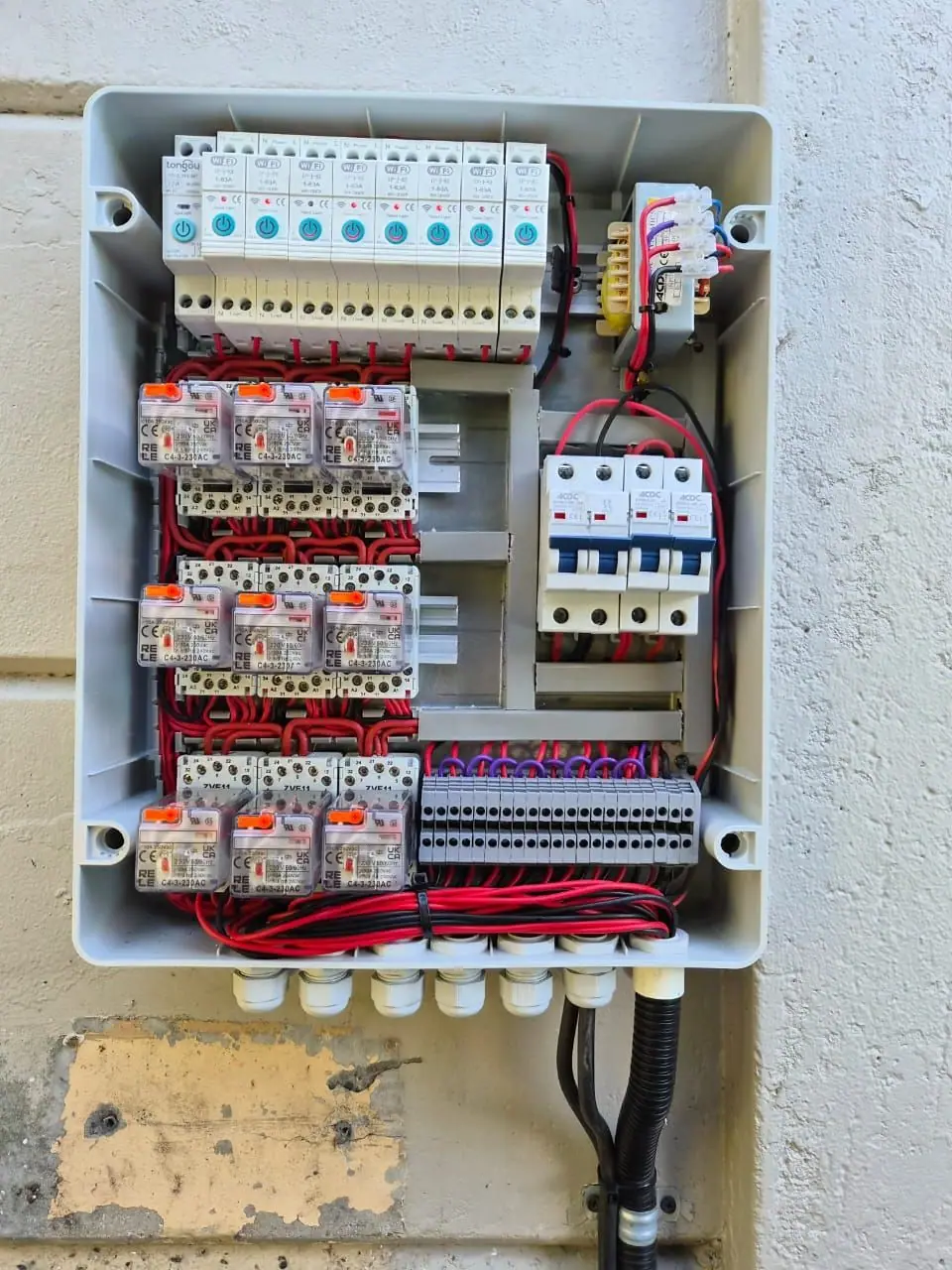
The control panel in our photographs is typical of what runs a machine: contactors that switch the motor, overload relays that trip it if it draws too much current for too long, and relays and timers that set the sequence of operation.
Small motors can be started direct-on-line. Larger ones draw a heavy current at start-up, so they are started through a star-delta starter, a soft starter or a variable speed drive, which also allows the motor's speed to be controlled.
Phase failure protection matters on any three-phase motor. If one phase is lost, a running motor can keep turning on the other two, overheat and burn out. A phase failure relay switches it off instead. Every panel we wire is labelled, and the wiring diagram stays in the panel door for whoever works on it next.
How is a supply upgraded through the City or Eskom?
Through an application to whichever utility supplies the property. Most of Cape Town is supplied by the City, but some areas are supplied directly by Eskom, and the process depends on which. For a City supply, only the property owner can apply for a new or modified connection, so a tenant needs the landlord to apply. The City then checks whether its network can take the extra capacity and quotes for its side of the work.
The building's side is ours: the cable from the meter, the new main board, the three-phase distribution and the CoC. Utility lead times vary, so the application should start before the machinery is ordered, not after it has been delivered.