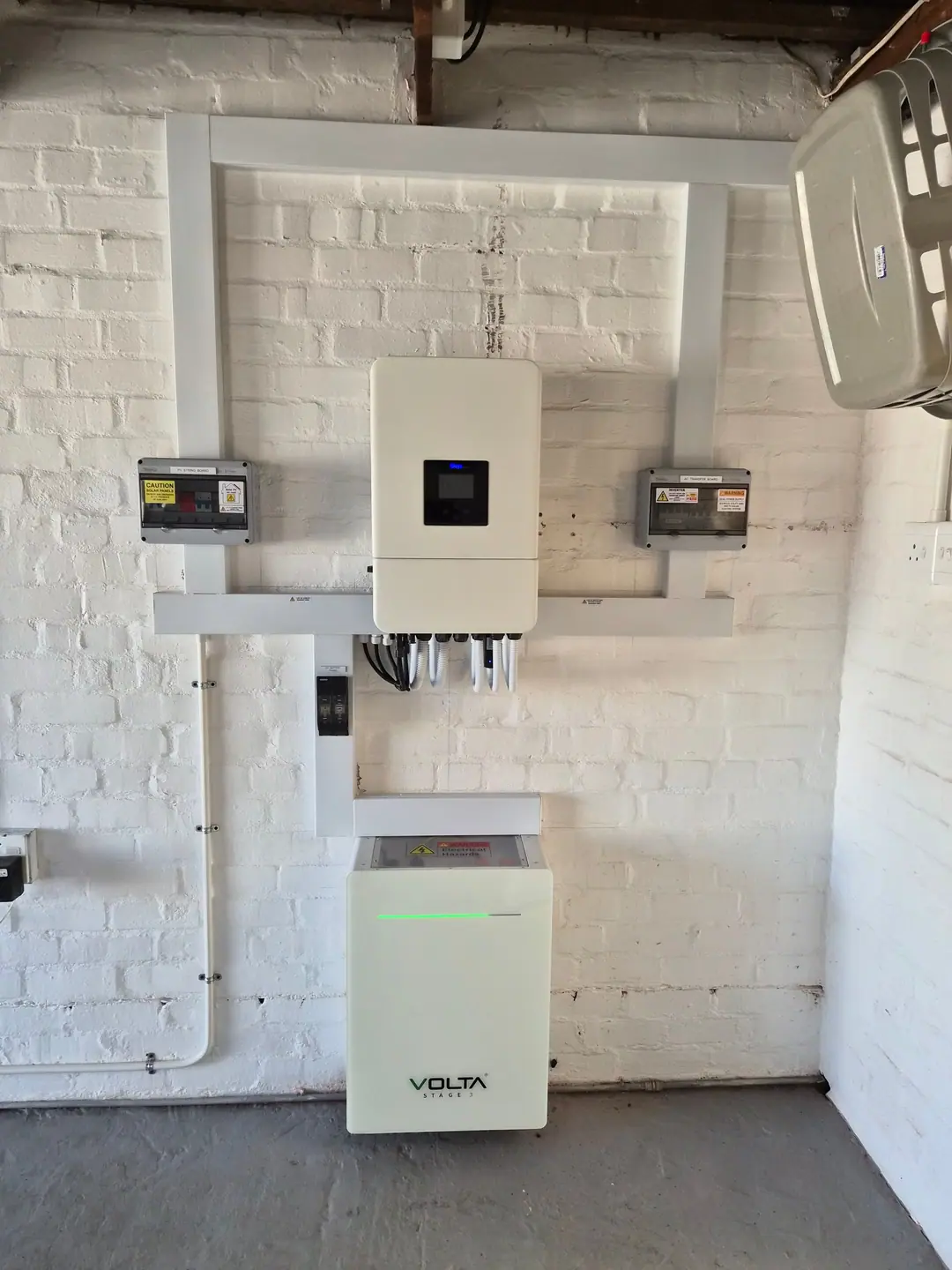

Electro-Spark installs inverter and battery backup systems in Cape Town, moving essential circuits onto a separate inverter DB so a smaller lithium battery lasts longer during an outage. The inverter is sized for motor start-up surges and must be on the City of Cape Town's approved list, and the system must be registered even without solar panels.
What is an essential-loads board?
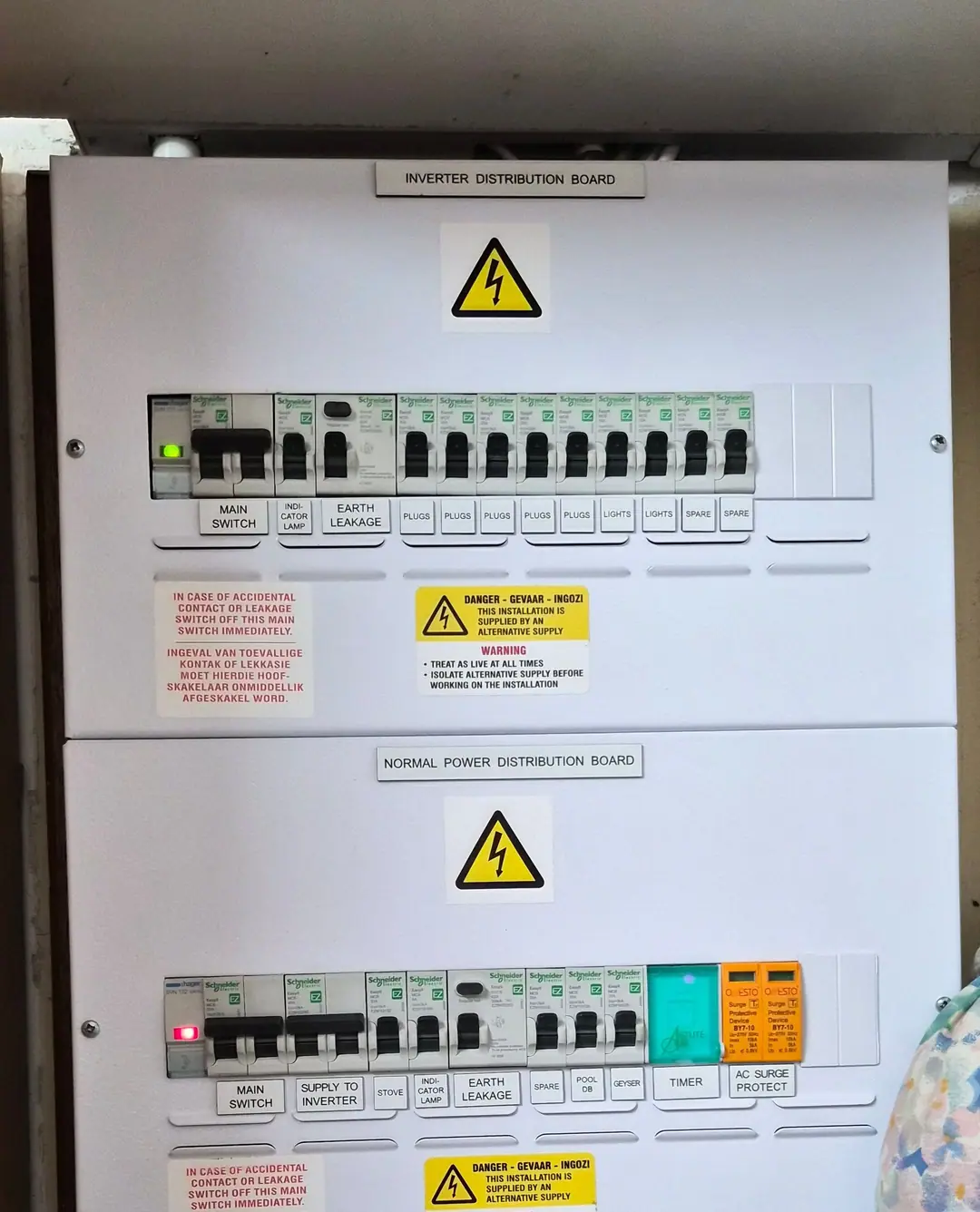
An essential-loads board, or inverter DB, is a separate distribution board that carries only the circuits you need during an outage. The photo shows two boards, one above the other. The top one is the inverter DB, fed by the inverter, with its own main switch and earth leakage. It carries the circuits that have to keep running, such as lights and the plugs you rely on. The bottom board is the normal-power DB, fed from the grid, and runs everything else, such as the stove, the geyser and the pool pump.
When the grid goes down, the battery does not have to carry a kettle or a geyser. It carries the essentials, and it carries them for much longer. Splitting the board is often a better use of money than buying a bigger battery.
Both boards are labelled circuit by circuit and carry the warning notices a dual-supply installation needs, so anyone working on the property knows there are two sources of power. If your existing board is old or full, it may make sense to replace it at the same time. See DB board upgrades.
How big a battery do I need?
Large enough to run your essential loads for as long as you need them, which is a straightforward calculation. List what has to run and roughly how many watts each draws, then multiply by the hours you need. Lights, a fridge, Wi-Fi and a TV drawing 500 W together for four hours is 2 kWh. Add a margin, and allow for the battery never being fully drained.
Check the usable capacity, not only the nameplate. Lithium iron phosphate batteries, the type most hybrid systems now use, can be discharged much further than older lead-acid batteries without shortening their life, which is why they have largely replaced them. The battery's management system communicates with the inverter, so the two have to be compatible.
With solar panels on the roof, the battery recharges from the sun during the day. Without panels, it recharges from the grid between outages, which works as long as the gaps between outages are long enough.
Sizing the inverter for start-up surges
The inverter's rating in kilowatts is the most it can supply at one moment. It has to cover everything on the backup board running together, plus the surge when a motor starts. Fridge and freezer compressors, gate motors, borehole and pressure pumps all draw several times their running current for a moment when they start.
An inverter that appears adequate on paper can trip when the fridge and the gate motor start together. We assess what actually starts on your essential board and select the inverter accordingly.
Can I install an off-grid inverter in Cape Town?
Not for a new system on the City's supply. Since 1 October 2023 the City of Cape Town has not accepted new applications for standby or off-grid systems on its network. All new systems are treated as grid-tied, and the inverter has to be on the City's approved list. For a house or business on the City's supply, that means a City-approved hybrid inverter. A property with no connection to the grid at all is a different case.
An off-grid or standby inverter works separately from the grid, usually through a changeover. A hybrid inverter works with the grid, the panels and the battery at once. It can run your essential loads from solar, charge the battery, and draw from the grid when it needs to. It can be set not to export to the grid if you do not want to sell power back.
A battery backup system without panels still has to be registered with the City, because the inverter is connected to your supply. See SSEG registration.
Installing batteries safely
Lithium batteries store a great deal of energy in a small enclosure. They go on a wall or stand away from heat and direct sun, with the DC cable between battery and inverter sized for the current and protected by the correct DC breaker or fuse. SANS 10142-1-2 covers energy storage in grid-connected installations, and the CoC for the installation has to include it.