

Electro-Spark traces tripping breakers and electrical faults in homes across Cape Town. A board trips for one of three reasons: an overloaded circuit, a short circuit, or current leaking to earth, which the earth leakage unit detects. We identify the cause and the circuit, test it, and repair the fault rather than simply resetting the switch.
Why does my DB board keep tripping?
A board trips because a circuit is overloaded, because there is a short circuit, or because the earth leakage unit is sensing current leaking to earth. Which switch dropped, and how it dropped, indicates which of the three you are dealing with.
- Earth leakage trip: the earth leakage unit (usually a wider switch with a test button) drops, taking a whole group of circuits off at once. It reacts to a small current, around 30 milliamps, finding a path to earth, often through water or damaged insulation.
- Overload: a single circuit breaker trips after running for a while, typically when the kettle, heater and microwave are all on the same plug circuit. It resets without difficulty and trips again the next time the same load is on.
- Short circuit: a breaker trips instantly, sometimes with a crack or a flash at the plug, and trips again as soon as you push it up. Common causes are a screw or nail through a cable when something was hung on a wall, a damaged appliance cord, or rodents chewing cable in the roof.
Why does the earth leakage trip when it rains?
Water reaches outdoor plugs, garden lights, gate motors, pool pumps and cable joints in a leaking roof, and wet insulation lets a small current leak to earth. The earth leakage unit responds as it is designed to. Cape Town receives most of its rain in winter, which is when earth leakage calls increase.
The pattern is the most useful clue. If the board trips during or after rain and holds once things dry out, the fault is almost always outside or in the roof. On coastal properties, salt air corrodes outdoor fittings faster, so they begin to leak sooner.
How can I find the faulty circuit safely?
You can often identify which circuit is causing an earth leakage trip before we arrive, using only the switches on the front of the board. Do this only with dry hands, standing on a dry floor. Never remove the panel that covers the wiring.
- Switch every circuit breaker off.
- Push the earth leakage switch back up.
- Switch the breakers on one at a time, waiting a few seconds each time.
- When the earth leakage drops again, the last breaker you switched on is the likely cause. Leave that one off and switch the rest back on.
- Unplug everything on that circuit and try it again. If it now holds, one of the appliances is at fault.
What not to do when a breaker keeps tripping
Do not hold a breaker up or tape it in place. Do not put thicker fuse wire into an old fuse carrier. Both remove the protection that prevents the fault from becoming a fire. If a breaker trips instantly every time, or you see scorching or smell burning, leave that circuit off and contact us.
What does a warm plug or a burning smell mean?
It usually means a loose or overheating connection. A plug or switch that is warm to the touch, a faint smell of hot plastic, brown marks around a socket or a light that flickers when something else switches on are all signs of it. They often appear before a breaker trips, because a bad joint can heat up without drawing enough current to trip anything.
Switch that circuit off at the board and stop using the plug. A loose connection deteriorates with every heat cycle.
What should I send before a visit?
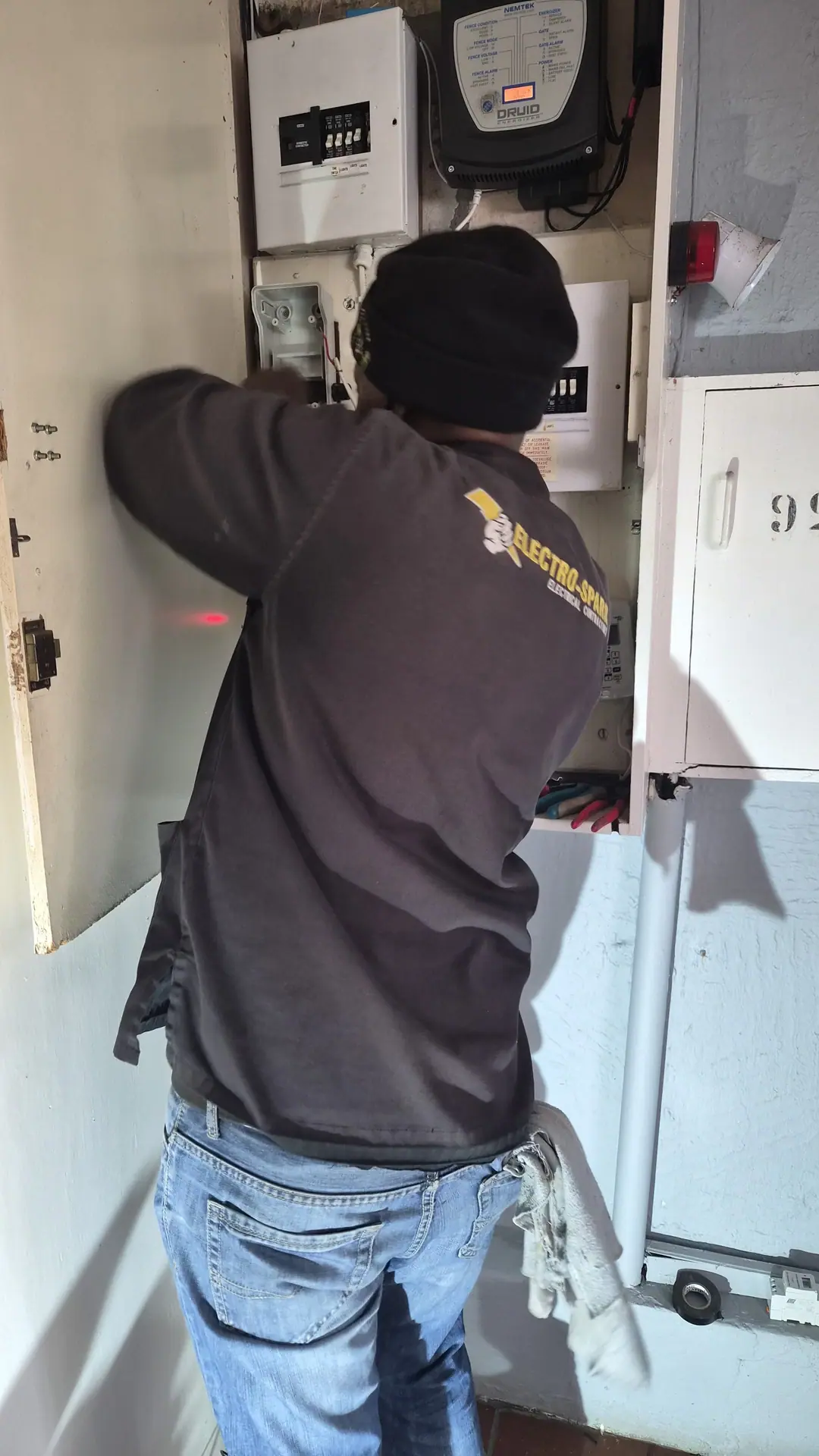
A photo of the DB board with the door open is the most useful thing you can send. It shows us which switch dropped, what kind of protection the house has and how old the board is. Add a line on when it trips (constantly, when it rains, when the kettle is on) and anything that has changed recently, such as a new appliance or work in the roof.