

Electro-Spark is an electrical contractor and solar installer based in Table View, serving Blouberg, Parklands, Sunningdale, Milnerton and Melkbosstrand on Cape Town's West Coast. We handle compliance certificates, fault finding, DB board upgrades, home solar and battery backup, and we specify fixings, enclosures and connectors for the salt air and wind of the coast.
An electrician based in Table View
Electro-Spark is based in Table View, so the Blouberg and West Coast side of Cape Town is the part of the city we know best. We work in Table View, Parklands, Sunningdale, Bloubergstrand, Big Bay, West Beach, Milnerton and along the coast to Melkbosstrand. The business is owner run, and the owner supervises the work.
Our work here covers what a home typically needs: compliance certificates for sales, fault finding when a circuit keeps tripping, DB board upgrades, lights and plug points, and home solar with inverter and battery backup.
A coastal location changes how some of that work should be done. The sections below set out what we look for on a Blouberg or West Coast property that a job further inland would not require.
Why does salt air matter for electrical work on the coast?
Salt air corrodes metal, and corroded connections run hot. Anything metal close to the beach at Bloubergstrand, Big Bay or West Beach is exposed to salty, damp air. Salt settles on terminals, enclosures and fixings, holds moisture against them and slowly corrodes them. Corrosion loosens connections and raises their resistance, and a high-resistance connection runs hot. On the DC side of a solar system, a hot, corroded connector is where arcing faults start.
On coastal jobs we take these additional measures:
- Outdoor isolators, enclosures and junction boxes rated for the weather, with cable entries sealed and, where possible, entering from below so water cannot run in.
- Stainless or suitably coated fixings on roof hooks and rails, and no dissimilar metals in contact where they would corrode against each other.
- Inverters and batteries mounted indoors or under cover, out of wind-driven spray, with space around them for air to circulate.
- DC connectors used as matched pairs from the same manufacturer and crimped with the correct tool, because a mismatched or badly crimped connector is the usual weak point.
Solar panels and the south-easter
Through spring and summer the south-easter blows strongly across the Blouberg coast, and the open stretch between Bloubergstrand and Melkbosstrand takes the full force of it. Wind lifts panels. The load on an array depends on the roof pitch, the exposure of the house, and how close the panels sit to the roof edges and ridge, where uplift is strongest.
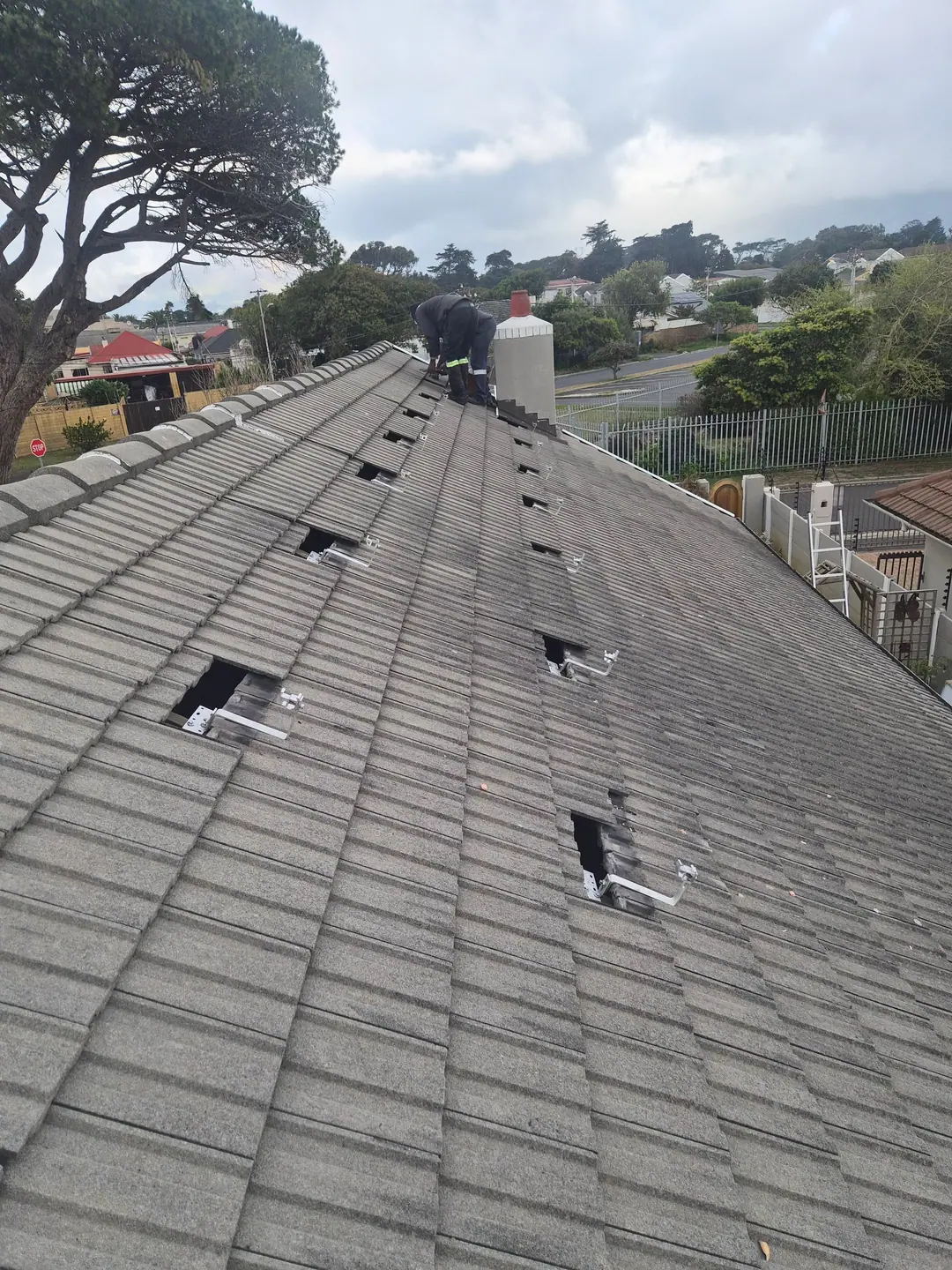
For that reason, roof hooks are fixed into the rafters, never into battens or tiles alone, and arrays are kept back from the edges of the roof. Tiles are lifted, the hook is fixed to the timber, and the tile is notched to sit flat over it so the roof continues to shed water. The photo on this page shows that stage of an installation, before the rails are fitted.
The wind also carries sand and salt, which leave a film on the glass, and panels near the beach lose output to it faster than panels inland. Rinsing with clean water and a soft brush restores most of it. Avoid pressure washers and harsh detergents, which can damage the seals and coating.
If your panels were installed a few years ago and the isolators have not been opened since, a solar maintenance visit checks the connections, the fixings and the inverter's fault history before corrosion leads to a failure.
Estates, complexes and body corporates
Much of the housing in Parklands, Sunningdale and Big Bay is in newer estates and sectional title complexes, which affects who must approve work before it starts.
In a sectional title scheme the roof is usually common property, so a unit owner needs the trustees' written consent before panels are installed, and larger changes to common property can require a body corporate resolution. Many schemes now have a solar policy that sets where panels may go and how cables must run. Estates managed by a homeowners' association usually have architectural rules on what may be visible from the street. We recommend obtaining these rules before requesting a quote.
For a complex considering a shared system, the body corporate solar page covers the options. Managing agents responsible for several buildings on the West Coast can start at property managers.
Newer houses have their own considerations. Some estate homes were handed over with DB boards filled to the last way, leaving no room for an inverter changeover or an additional circuit. Adding solar or backup to one of these usually begins with a DB board upgrade or a split into an essential board and a normal-power board.
Pools, pumps and heavy loads
Many homes in Table View, Parklands and Melkbosstrand have a pool, and a pool pump is one of the largest steady loads in a house. Add a geyser, an oven and an air conditioner, and it is easy to ask more of a backup system than it can deliver.
When we size a backup system, we divide the circuits into those that must keep running during load-shedding or an outage (lights, plugs, the fridge, Wi-Fi, the gate and alarm) and those that can wait (the geyser, the stove, the pool pump). On a solar system, the pump then runs on a timer in the middle of the day, off the panels, rather than off the battery at night. A geyser timer does the same for the geyser.
A pump motor also draws a surge when it starts, which can trip an undersized inverter. If your pool pump trips the earth leakage, the cause is often water in the pump's connection box or a failing motor winding, and fault finding starts there.