

Electro-Spark is an electrical contractor serving offices, shops and businesses in Century City, Tygerhof and Bosmansdam, Cape Town. We handle office and retail fit-outs, backup power for offices and server rooms, and ongoing maintenance for tenants and building managers, planning each job around the landlord's and the precinct's contractor rules.
Commercial electrical work in Century City
We carry out electrical work for offices, shops and businesses in Century City, around Canal Walk, and in Tygerhof and Bosmansdam, close to our base in Table View. The business is owner run, and the owner supervises the work.
Most Century City work falls into office and retail fit-outs, backup power for offices and server rooms, and ongoing maintenance for tenants and building managers.
Century City is a planned precinct of office blocks, retail around Canal Walk and residential buildings, laid out and managed as a single development. Nearby Tygerhof and Bosmansdam add older office and light commercial property. The buildings differ, but most jobs have one thing in common: a landlord or building manager between the tenant and the electrical supply.
What electrical work does an office fit-out involve?
A fit-out turns a shell into a working space, and the electrical work determines what that space can do. We plan the tenant's distribution board, the lighting layout, power points and floor boxes to the furniture plan, dedicated circuits for kitchens, printers and server racks, and separate circuits for anything that must keep running on backup.
Where tenants are billed separately, the board may need sub-metering, in the form the landlord specifies. At handover, the new installation needs a certificate of compliance. Agreeing the electrical plan early, before the ceilings are closed, avoids rework later.
Working to landlord and precinct requirements
Century City is a managed precinct. The Century City Property Owners' Association sets rules for contractors working within it, covering matters such as parking, site conduct and control of the workforce, and each building usually adds its own.
Building managers commonly want to know who will be on site and when, what will be isolated and for how long, and how noise, dust and access will be managed. Many buildings restrict when the supply may be switched off or when drilling is permitted. Send us the building's contractor rules with your request, so that the plan and the quote reflect them from the outset.
Changes to a building's main supply or common areas are the landlord's decision, even when the tenant is paying. On a fit-out, we liaise with the building manager directly on those points.
Backup power for offices
An office on backup does not need everything running. The usual essentials are the server rack and network, the phones, some lighting and a few work points. Air conditioning and kitchen appliances draw far more power and are normally left off the backup.
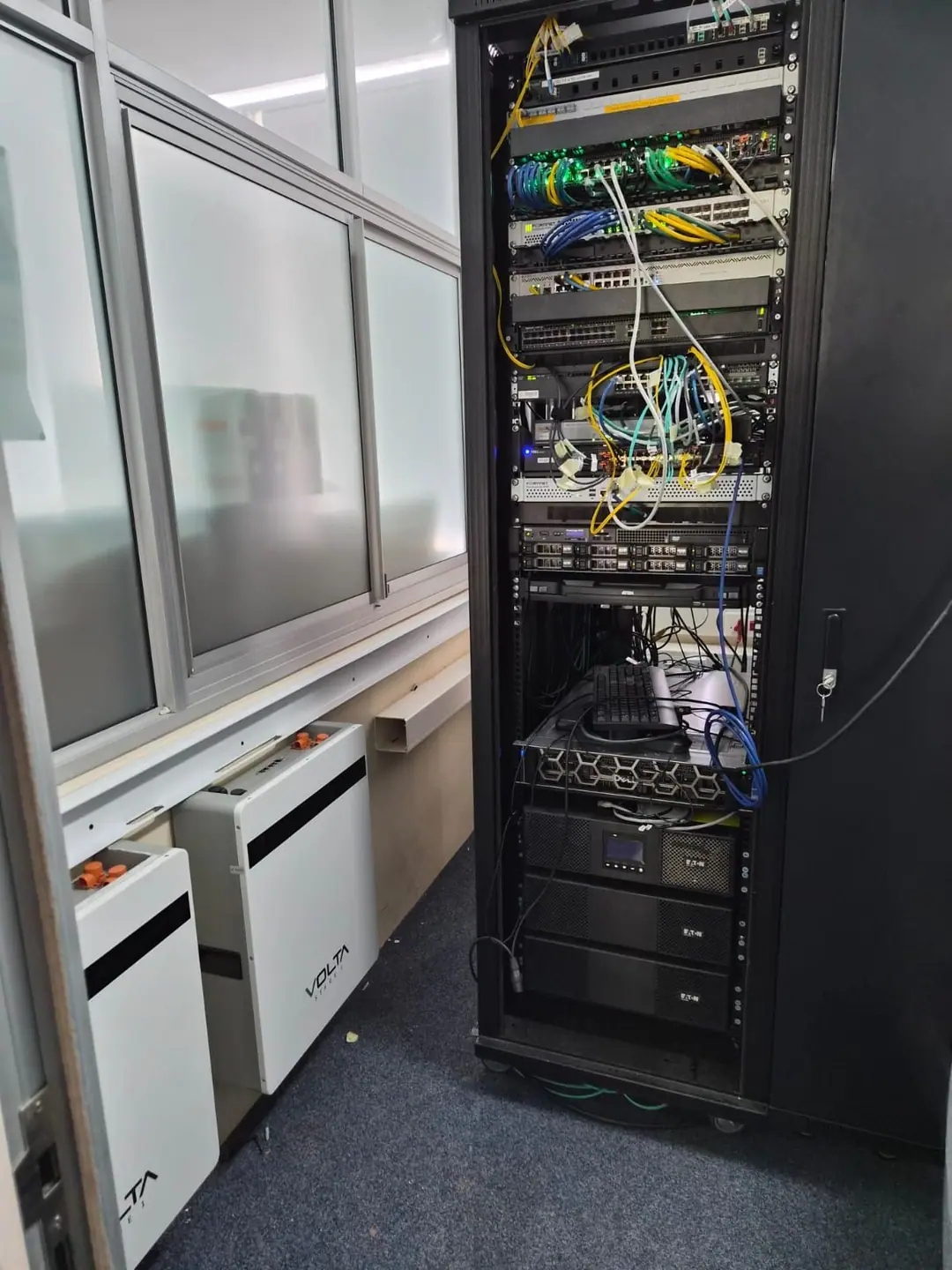
Lithium batteries installed beside a server rack, as in the photo on this page, are a common arrangement. They need ventilation, clearance, protection and a location the landlord approves.
The changeover has to be designed with the office's board. The usual approach is to move the essential circuits onto a separate inverter DB, so there is a clear division between what runs on backup and what does not. Labelled plug points on the backed-up circuits stop staff from connecting a kettle or heater and draining the battery early in the day.
Solar for landlords in Century City
In a leased building, rooftop commercial solar is a matter for the landlord, because the roof is not the tenant's to use. For the landlord, office buildings suit solar well: the load is highest during working hours, when the panels produce most, and air conditioning peaks on sunny afternoons when output is strong.
Any grid-tied or grid-capable system must be registered with the City of Cape Town, with an approved inverter, and in a managed precinct the property owners' association may have its own requirements for rooftop equipment. Section 12B allows the owner to deduct the full cost of a PV system of up to 1 MW in the first year, which your accountant can confirm.
Maintenance for tenants and building managers
Offices and shops wear their electrical installations in predictable places: lighting that fails or flickers, plug points loosened by years of use, overloaded extension leads under desks, and board labels that no longer match what is connected.
The Electrical Installation Regulations make the user or lessor responsible for a valid certificate of compliance, and leases usually state whether the tenant or the landlord carries that duty for the tenant's installation. Some leases also require the tenant to hand the space back with a valid CoC, so check yours before you move out. A maintenance contract keeps the installation safe in the meantime, and building managers with several properties can start at property managers.