

Electro-Spark designs and installs commercial solar systems for offices, shops, warehouses and workshops in Cape Town. Each array is sized to the building's daytime load so most of its output is used on site, connected through a City-approved three-phase inverter, and documented with the itemised quote and commissioning date an accountant needs for Section 12B.
How should a commercial solar system be sized?
A commercial system should be sized to the power the building uses during the working day. An office, shop, workshop or cold room uses most of its electricity between about eight and five, when the panels are producing. Every kilowatt-hour the array produces that the building uses on the spot replaces one you would have bought from the City. That is the cheapest energy solar can provide, because it needs no battery.
The design therefore starts with your load profile, not your roof size. Twelve months of municipal accounts show the seasonal pattern, and if your site has a smart meter, interval data shows what the building draws hour by hour, including weekends when it may be closed. We size the array so that most of what it produces on a normal weekday is used on site. An array larger than the daytime load can use sends more of its output back to the grid, where it earns far less.
Weekends and public holidays also count. A business closed on Saturday afternoon and Sunday will export or waste much of what the array produces over those days, and that has to be reflected in the numbers.
Can a business claim solar under Section 12B?
Yes. Section 12B of the Income Tax Act lets a business deduct 100% of the cost of a solar PV system of 1 MW or less in the year it is brought into use. For a PV system above 1 MW, the allowance is spread over three years (50%, 30% and 20%). The asset has to be owned by the taxpayer and used in its trade.
The temporary Section 12BA incentive, which allowed 125% for renewable energy assets, only applied to assets brought into use between 1 March 2023 and 28 February 2025. Systems commissioned now fall under Section 12B.
What qualifies, when a system counts as brought into use, and how batteries and other components are treated are questions for your accountant or tax advisor. We provide an itemised quote and the commissioning date they will need.
Roof structure, sheeting and access
Most commercial roofs in Cape Town are sheet metal on steel or timber purlins. Panel brackets clamp to the sheeting profile or fix through it into the purlins, and the roof has to carry the extra weight and the wind load. On a large array, or an older building, a structural engineer should confirm the roof can take it before anything is designed.
The condition of the sheeting matters too. An array stays on the roof for twenty-five years or more. If the sheeting is rusting or near the end of its life, it is far cheaper to replace it before the panels go on than to lift an array off a leaking roof later.
We also plan how people will reach the array for cleaning and repairs, where the DC cable runs to the inverter room, and where the isolation points are, labelled so your maintenance staff and the fire service can make it safe.
Why do business premises need a three-phase inverter?
Because most business premises have a three-phase supply. A three-phase inverter feeds all three phases, so solar offsets load on every phase and the supply stays balanced. A single-phase inverter connected to one phase of a three-phase building can leave that phase exporting while the other two still draw from the grid.
If the system also provides backup, three-phase equipment such as compressors, larger pumps, some motors and roller doors will only run from a three-phase inverter. The inverter still has to be on the City's approved list, and the installation still has to be registered with the City like any other system.
Backup for equipment that cannot go down
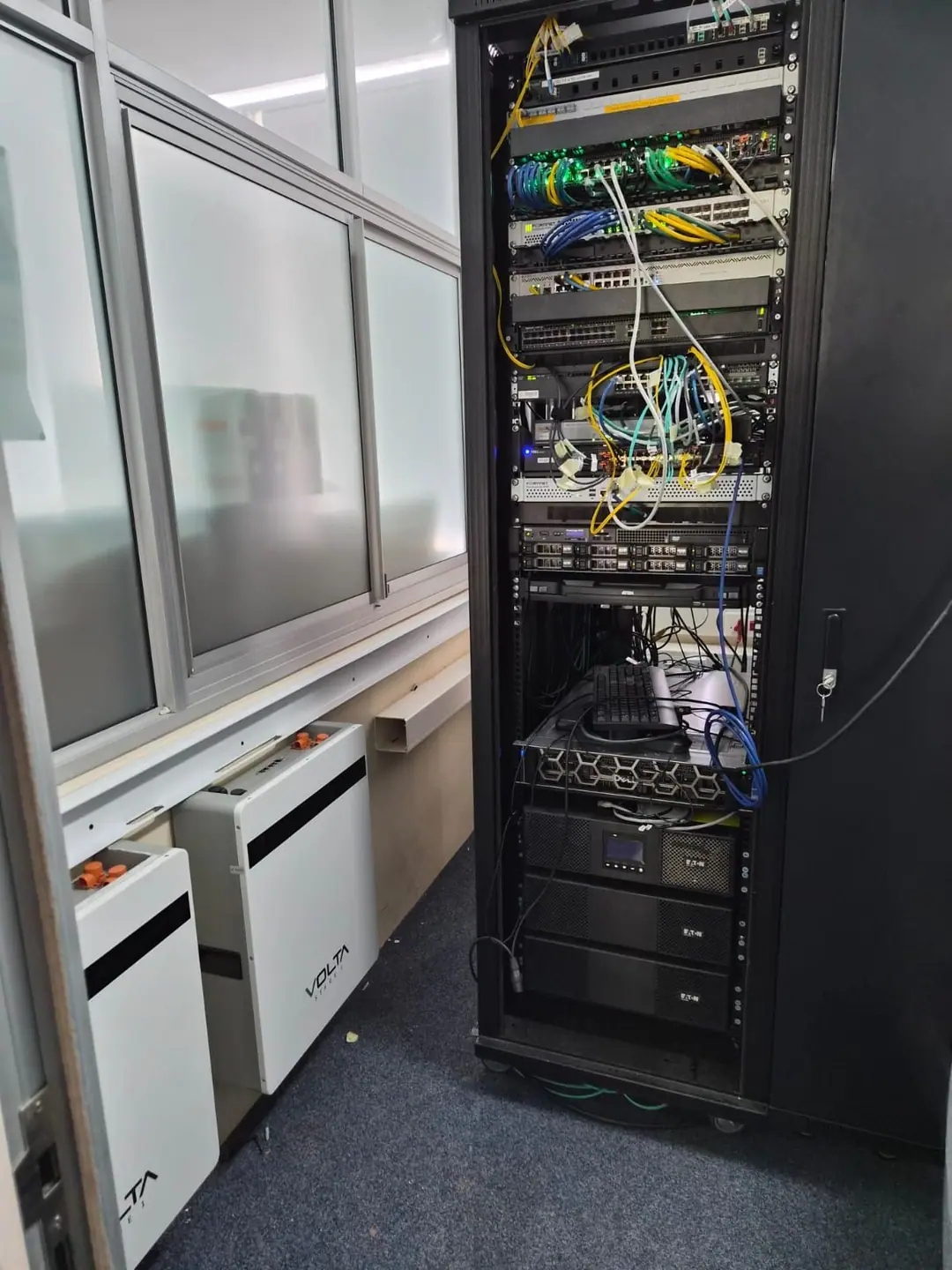
Some loads cannot wait for the grid: server rooms, tills and payment terminals, alarms and access control, refrigeration. These go on their own backup board, with lithium batteries sized to carry them for as long as you need. The server-room photo on this page shows lithium batteries installed next to an office server rack.
Separating critical loads keeps the battery bank to a sensible size. Carrying a whole building through an outage takes a very large battery. Carrying the server room and the front desk takes a much smaller one. See inverters and battery backup for how the split board works.