
Electro-Spark maintains and repairs solar systems in Cape Town, including systems installed by other companies. The work covers panel cleaning, corrosion on coastal sites, inverter error codes, blown string fuses, loose DC isolator terminals and spent surge protection. When taking over a system, we also check its City registration and certificate of compliance.
Cleaning panels near the coast
Cape Town's winter rain washes panels reasonably well. The dry summer months are different: dust, pollen and bird droppings build up, and near the sea a film of salt settles on the glass. On the Atlantic side, from Melkbosstrand to Camps Bay, that film can reduce output noticeably between rains.
Panels should be cleaned with clean, soft water and a soft brush or squeegee, early in the morning or late in the day while the glass is cool. Cold water on hot glass can stress it. Avoid pressure washers, abrasive pads and detergents that leave a residue, and check the panel manufacturer's cleaning instructions, because the wrong method can affect the warranty.
Working on a roof is the dangerous part. If the array cannot be reached safely from a ladder, the work should be done by someone with the right equipment.
What salt air does to the rest of the system
Salt affects far more than the glass. It attacks fixings, rail clamps, earth bonding connections and the DC connectors between panels. Enclosures that are not sealed properly let damp, salty air reach isolator terminals. Where two different metals touch, corrosion accelerates.
On coastal maintenance visits we look for rust on fixings and clamps, white corrosion on aluminium, discoloured or loose DC connectors, and moisture inside the string board and isolators. Parts that are corroding are replaced with hardware suited to the site.
What do inverter error codes mean?
Most inverter error codes fall into four groups: grid faults, isolation faults, battery communication faults and over-temperature faults. They appear on the display or in the app. Grid faults mean the inverter has seen the grid voltage or frequency go outside its limits and has disconnected, often briefly, sometimes because of a problem on your own supply. Isolation or insulation faults mean the inverter has measured leakage from the DC side to earth, often from moisture in a connector or a damaged cable on the roof, and these are commonly worse after rain. Battery communication faults mean the inverter and the battery's management system have stopped communicating, usually because of a cable, a setting or a firmware mismatch. Over-temperature faults point to poor ventilation or a failing fan.
Send us the exact code, the inverter make and model and a photo of the display on WhatsApp. That usually tells us what to bring.
Checking isolators, fuses and surge protection
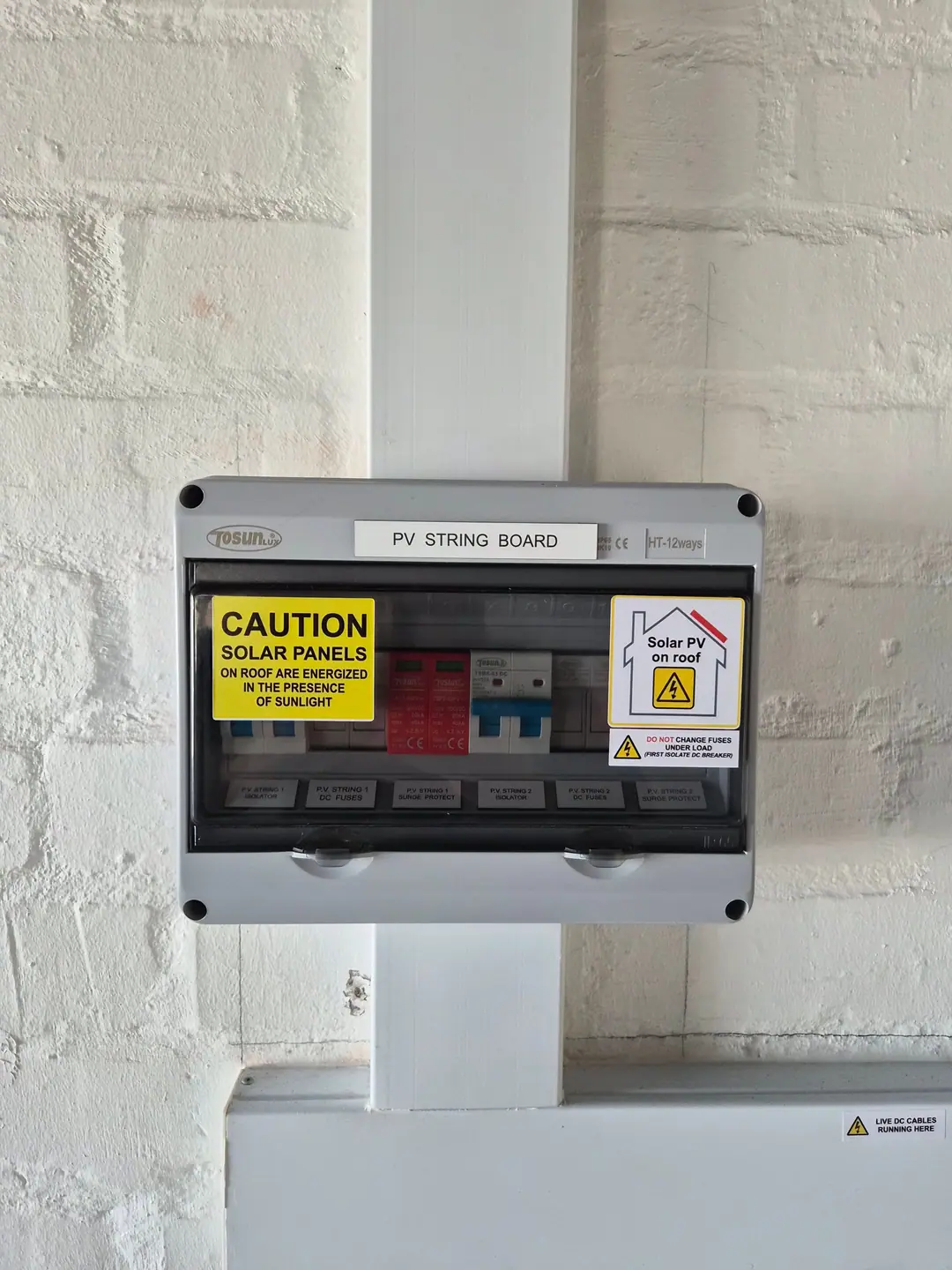
The PV string board is where most hidden faults sit. A string fuse can blow and leave one string producing nothing while the inverter continues with the rest, so the only sign is a lower daily total. A loose terminal on a DC isolator runs hot and discolours the plastic around it. A surge protection device that has taken a hit, often in a thunderstorm, shows a changed indicator window and needs replacing.
We check each string's voltage and current against the others, inspect and tighten terminals, test the isolators and replace spent surge protection. The photo is a PV string board with each string labelled, which makes this work quicker for anyone who opens it.
Can you take over a system someone else installed?
Yes. Many systems in Cape Town were installed during the worst of load-shedding by installers who have since moved on. If yours needs work and the original installer cannot be reached, we start with an inspection: whether the inverter is on the City's approved list, whether the system is registered, whether there is a CoC that covers it, the condition of the roof fixings and cabling, and whether the boards are labelled.
We then report what we found and what needs doing, in order of importance. If the system was never registered, see SSEG registration.