
Electro-Spark is an electrical contractor serving office buildings and older properties in the Cape Town CBD, the Foreshore, De Waterkant, Woodstock and Salt River. We handle office fit-outs, DB board upgrades, backup power for city offices, electrical layouts for building conversions and maintenance for property managers, planned around each building's access rules.
Commercial electrical work in the Cape Town CBD
We carry out commercial electrical work in the Cape Town CBD, the Foreshore, De Waterkant, Woodstock and Salt River, from our base in Table View. The business is owner run, and the owner supervises the work.
The building stock here ranges from modern towers on the Foreshore to much older buildings in the city centre and converted warehouses in Woodstock and Salt River. The work follows that range: office fit-outs, DB board upgrades, backup power, maintenance and work for property managers.
Older buildings and ageing reticulation
Many buildings in the Cape Town CBD were wired for a very different load. A block designed for typewriters and a few lights now supplies air conditioning, kitchens, server rooms and dozens of chargers on each floor. The risers and sub-mains carrying power up the building may be decades old, and the floor boards may have been extended piecemeal by several contractors.
Before significant load is added to a floor, the question is whether the riser and the floor's supply can carry it. We check the cable sizes, the protection and the existing load before a new tenant's design is settled. Sometimes the answer is a new sub-main, which is the landlord's decision.
Buildings older than 60 years are protected under the National Heritage Resources Act, and parts of the city are in heritage protection overlay zones. Work that changes a building's appearance, such as external conduit or rooftop panels, can require approval.
Access, parking and building rules
Work in the city requires planning. Parking and loading space are limited, materials go up in goods lifts, and building management usually needs to know who is on site and what is being isolated.
Many buildings restrict when the supply may be switched off, when drilling or noisy work is permitted, and which lifts contractors may use. Send us the building's contractor rules when you request a quote, so the plan and the quote reflect them.
Conversions in Woodstock and Salt River
Woodstock and Salt River have many older industrial buildings converted to offices, studios, shops and restaurants. They often come with a three-phase supply from their industrial past and very little distribution suited to the new use.
A conversion is an opportunity to plan the electrical layout properly: a new distribution board, circuits matched to the new layout, and phases balanced across the loads. A restaurant or commercial kitchen needs heavy dedicated circuits for ovens and extraction. See three-phase installation.
Backup for city offices
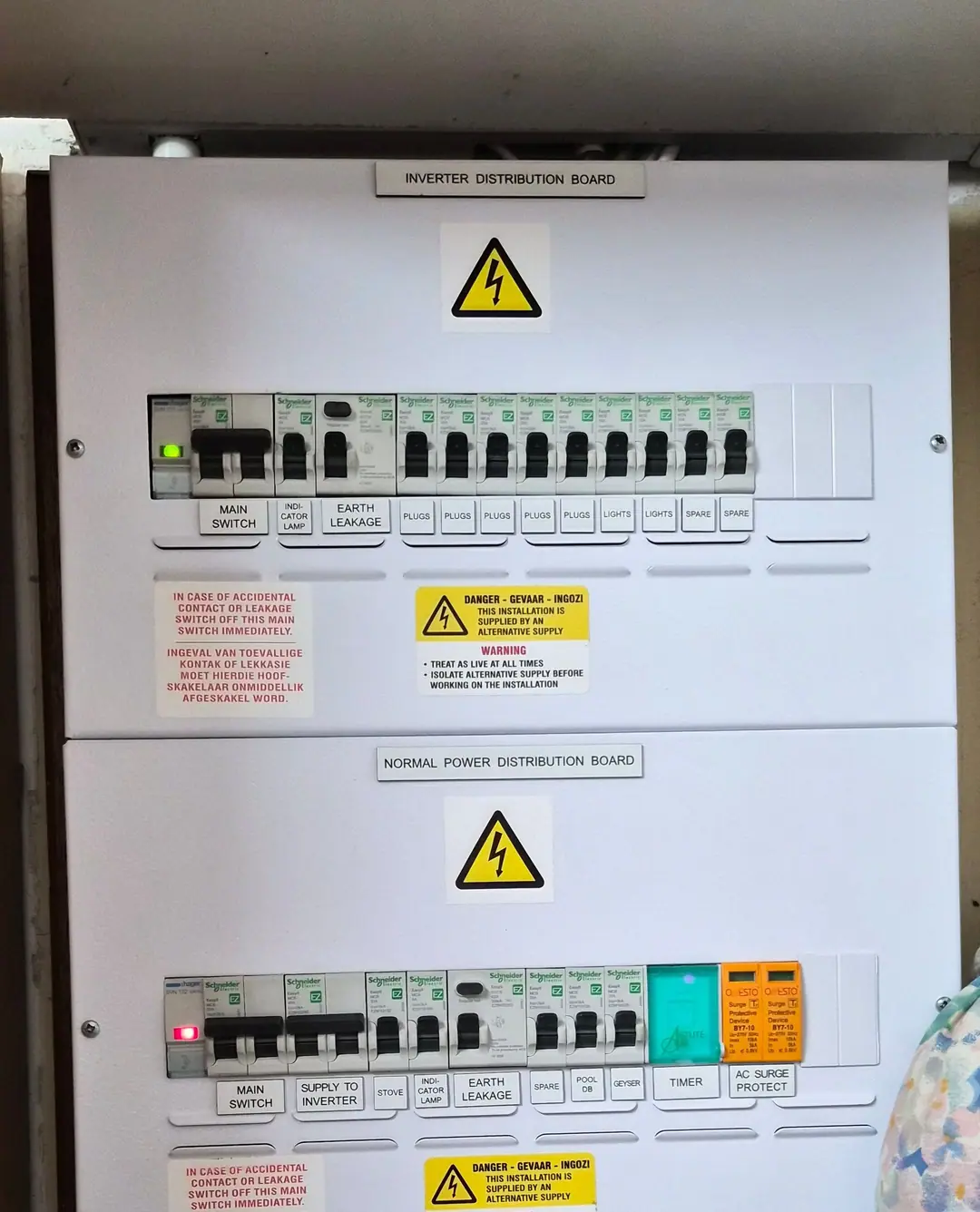
In a city office, backup usually covers the server rack, network, phones, and some lighting and work points. The photo on this page shows a common arrangement: an inverter DB above the normal-power DB, so the essential circuits run from the inverter and everything else stays on the grid.
In a leased building, batteries need the landlord's approval and a suitable location with ventilation and clearance. Solar is rarely an option for a single tenant in a city building, because the roof is shared and usually small relative to the number of floors below it. Backup charged from the grid is the practical solution for most CBD offices.
Tenant changes, lighting and compliance
City office buildings change tenants often, and each change tends to leave something behind: circuits nobody can identify, boards labelled for a previous layout, and extension leads standing in for plug points that were never installed. Before a new fit-out, it is worth tracing and labelling the existing floor board, so the new design starts from what is actually there.
The Electrical Installation Regulations require the user or lessor to hold a valid certificate of compliance for the installation, and new work must be certified when it is completed. Leases differ on whether the landlord or the tenant carries that duty for the tenant's installation, so check yours.
Lighting is usually the simplest saving in an older office. Replacing fluorescent fittings with LED panels or tubes, with the old ballasts removed, reduces the lighting load and ends the flicker and failed tubes. See lighting and plug points.