
Electro-Spark is an electrical contractor and solar installer serving Cape Town's Northern Suburbs, including Durbanville, Bellville, Brackenfell, Kuils River, Parow and Goodwood. We install home solar and battery backup sized to how a household uses power, upgrade DB boards, rewire older houses and issue compliance certificates, from our base in nearby Table View.
Electrical and solar work in the Northern Suburbs
We work across the Northern Suburbs: Durbanville, Bellville, Brackenfell, Kuils River, Edgemead, Plattekloof, Parow and Goodwood, a short drive from our base in Table View. The business is owner run, and the owner supervises the work.
Our work here includes home solar, inverter and battery backup, DB board upgrades, rewiring in older houses, compliance certificates for sales and fault finding.
Two factors distinguish Northern Suburbs work from the coast. Summers inland are hotter, which affects inverters, batteries and panels. And the housing stock is mixed, so one street can include a house that needs rewiring and another that only needs its backup sized correctly.
How does summer heat affect a solar system?
Heat reduces the output of inverters, batteries and panels, and away from the sea breeze Northern Suburbs summers are very hot.
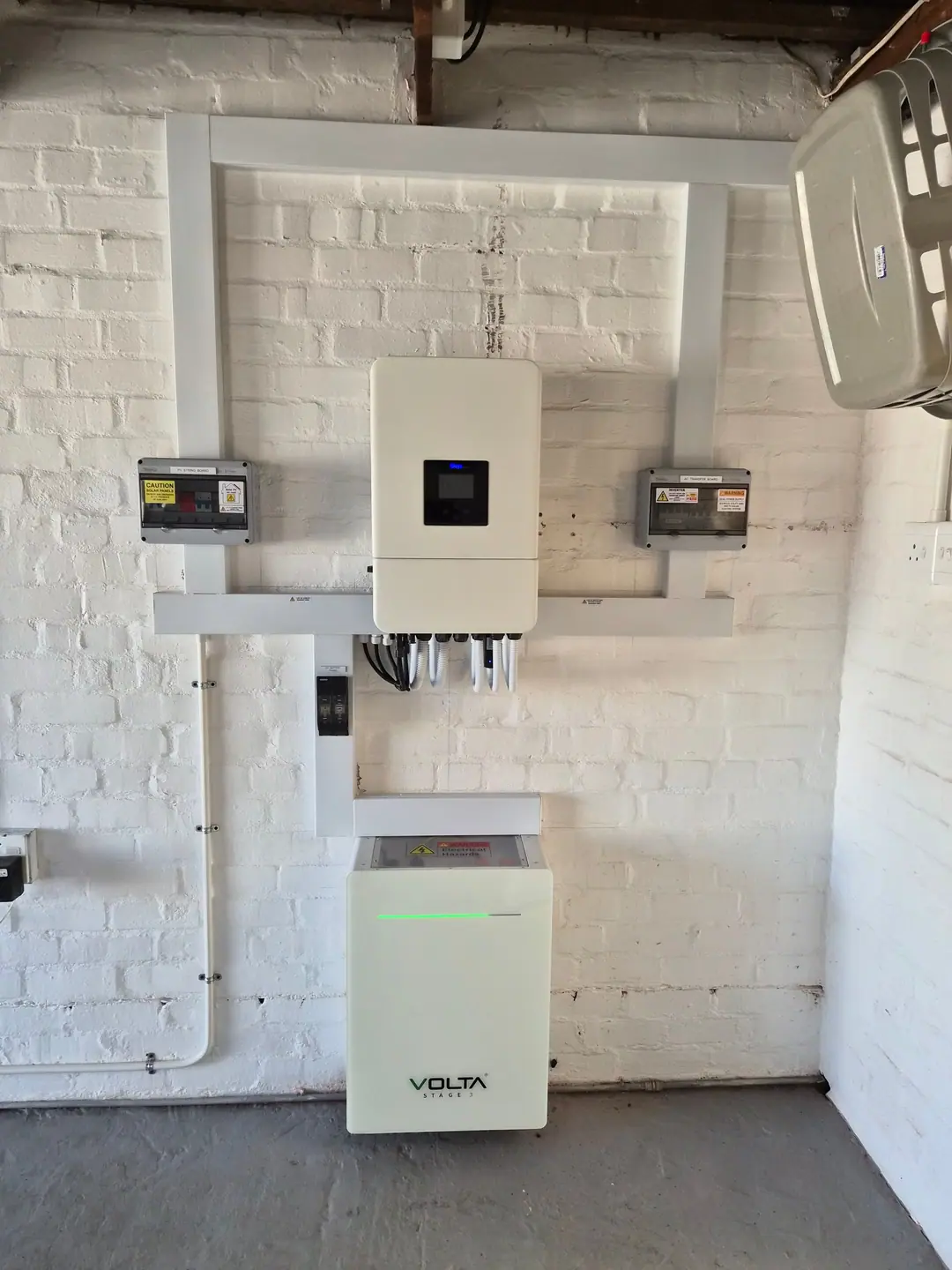
Inverters derate when they get hot. As the heat sink temperature rises, the inverter reduces its own output to protect itself, which means less power at exactly the time the panels are producing most. An inverter fixed to a sun-facing wall, or enclosed in a cupboard or roof space with no airflow, will spend summer afternoons running at reduced output. We look for a shaded wall or an indoor position with the clearance around the unit that the manufacturer specifies.
Lithium batteries also have an operating temperature range. Their management system slows or stops charging when the cells become too hot, so a battery in a hot garage may not fully charge on a summer day. The same principle applies: shade, airflow and no nearby heat source.
Panels lose output as they heat up. A panel's rated output is measured at a cell temperature well below what a roof reaches in a Durbanville or Brackenfell summer, so actual midday output is lower than the figure on the label. Mounting on rails leaves an air gap beneath the panels, which helps them shed heat, and we allow for summer losses when sizing the array.
How is backup sized for a larger family home?
We size backup from what the house actually uses, not from the size of the house. Many Northern Suburbs homes are larger than average, with more occupants, more circuits, sometimes two geysers, and air conditioning. That makes estimating a backup system costly in either direction: too small and it trips, too large and you pay for capacity you never use.
Your municipal bill gives the monthly total, and a reading history from a prepaid or smart meter is even more useful. From there we establish what must run during an outage and for how long, then size the inverter for the peak load and the battery for the hours.
Roof direction matters as much as the number of panels. A north-facing roof produces the most energy over a day. An array split across east- and west-facing roofs produces less at noon but spreads output across the morning and late afternoon, which can suit a household that is busiest before school and after work. Many Northern Suburbs houses have both, and we use whichever matches how the household uses power.
Some larger homes have a three-phase supply. This changes the equipment: either a three-phase inverter, or a single-phase inverter carrying the essential circuits from one phase. The right choice depends on where the heavy loads sit, and we check the supply before recommending anything.
Older homes in Parow, Goodwood and Bellville
Parts of Parow, Goodwood and Bellville have older housing, and older houses often still have wiring and DB boards from the time they were built. Common findings include boards with no earth leakage unit, circuits with no earth conductor, undersized cable feeding a kitchen that now has far more appliances than it was wired for, and additions over the years that were never properly installed.
These issues usually surface at one of two points: when the house is sold and needs a CoC, or when the owner wants solar and the board has no space for the changeover. In both cases the remedy may be a DB board upgrade, a partial rewire of the worst circuits, or both. We test before recommending a full rewire, because not every older house needs one.
Newer estates in Durbanville and Brackenfell
The newer estates around Durbanville, Brackenfell and Kuils River raise different questions. The wiring is modern, but estate rules often control what may be visible from the street, including panels on a front-facing roof and inverters on outside walls. Obtain the estate's rules before planning a solar layout.
Newer homes are also the easiest to plan correctly from the outset. If you are building or extending, we can install conduits for a future inverter and panels while the walls are open, which costs far less than chasing them in later. See renovations and new builds.