
Electro-Spark is an industrial and commercial electrical contractor serving Epping Industria 1 and 2, the Elsies River industrial area and Ndabeni in Cape Town. We install and maintain three-phase installations, motor circuits and control panels, wire cold storage and refrigeration, carry out planned maintenance for working plants, and install solar on suitable industrial roofs.
Industrial electrical work in Epping
We carry out industrial and commercial electrical work in Epping Industria 1 and 2, the Elsies River industrial area and Ndabeni, from our base in Table View. The business is owner run, and the owner supervises the work.
Epping is one of Cape Town's main industrial areas, home to manufacturing, distribution and food businesses, with the Cape Town Market, the Western Cape's largest fresh produce market, at its centre. The electrical work that follows includes three-phase installation, motor circuits and control panels, maintenance contracts and commercial solar.
Motors, starting current and three-phase
Most machines in an Epping factory are driven by three-phase motors, and most motor problems are electrical before they are mechanical.
- Starting current: a motor started direct on line draws several times its running current for a moment. On a large motor that can dip the supply or trip upstream breakers. A star-delta starter, soft starter or variable speed drive reduces it.
- Overload protection: set to the motor's nameplate current, not the breaker's. An overload set too high allows a motor to overheat and fail.
- Phase loss: a motor that loses one phase keeps turning on two, draws far more current and burns out its windings. A phase-failure relay stops it.
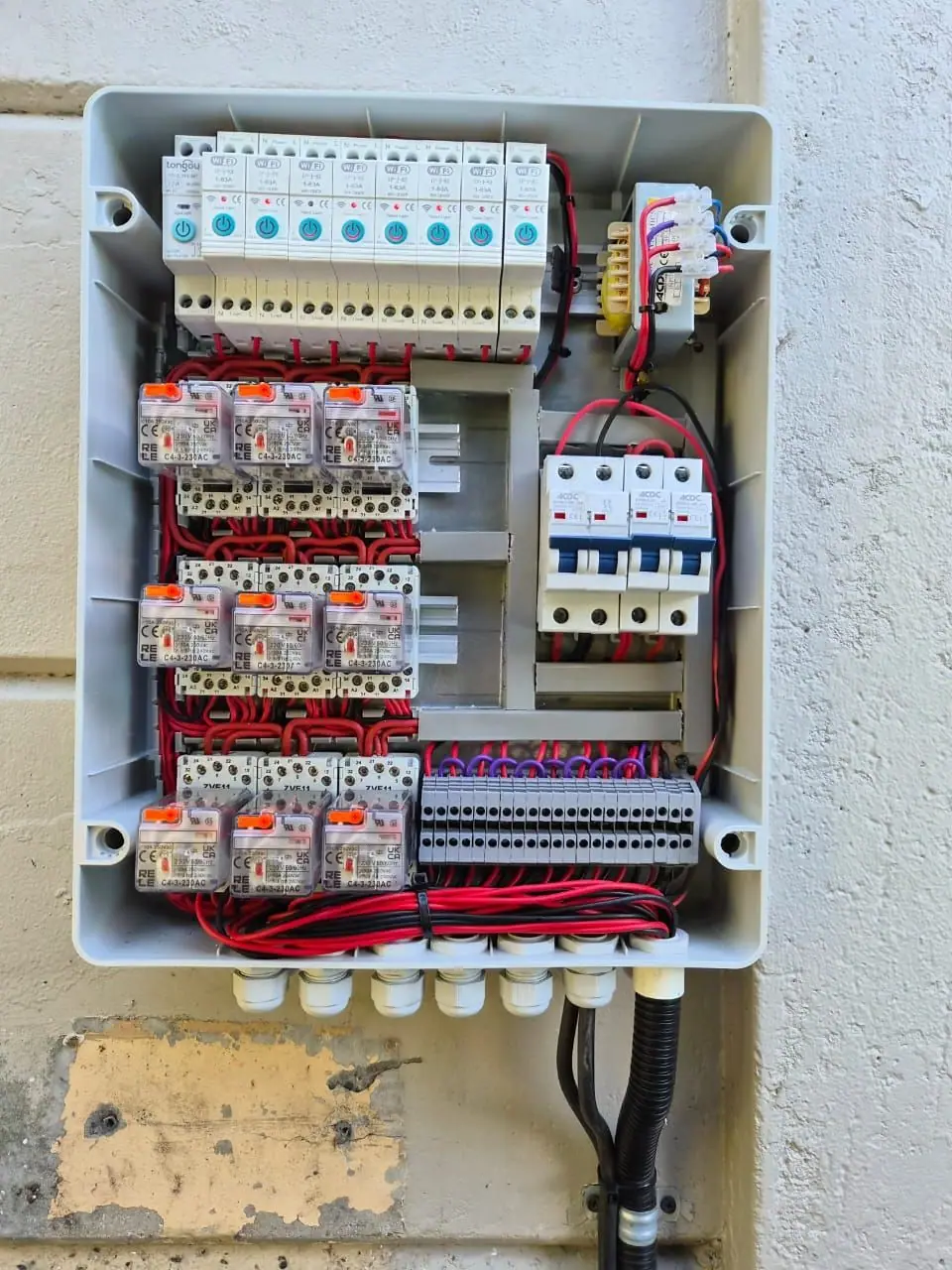
- Control panels: contactors wear, terminals loosen and labels go missing. A panel that is properly wired and labelled is much faster to fault-find.
Cold storage and refrigeration
For a cold room or refrigerated warehouse, a trip is measured in lost stock. Compressors and evaporator fans need dedicated, correctly rated circuits, and their protection has to allow for compressor starting current without being so loose that a genuine fault goes unnoticed.
Backup for cold storage usually covers the controls and monitoring rather than the full compressor load. Keeping the controllers, alarms and temperature logging running during an outage gives you a record of what happened, and the plant restarts in an orderly way when power returns. Large refrigeration loads running through the day also pair well with solar, since that is when the panels produce.
Maintenance on a working plant
Planned maintenance costs less than a breakdown, particularly in a plant running shifts. A typical schedule covers tightening terminations on boards and panels, checking contactors and overloads, testing earth leakage and earth continuity, looking for heat damage on cables and connections, and confirming that emergency stops actually stop the machine.
Work is planned with you to limit the effect on production: circuit by circuit where possible, with full shutdowns agreed in advance. The Electrical Installation Regulations make the user or lessor responsible for a valid certificate of compliance, and every new circuit or machine connection must be certified. A maintenance contract puts all of this on a regular schedule.
What is power factor correction, and is it worth fitting?
Power factor correction reduces the reactive current a plant draws, and whether it pays depends on your tariff and your load. Motors draw reactive current as well as the current that does the work. A plant with many lightly loaded motors can have a poor power factor, meaning the supply carries more current than the useful work requires. Cables and transformers run warmer, and if your tariff includes a demand charge measured in kVA, as larger business tariffs often do, you pay for that additional current every month.
Correction is usually a bank of capacitors switched in steps at the main board. To assess whether it is worth fitting, we start with the bill and a measurement of the load over a working day.
Solar on industrial roofs
Factories and cold stores use most of their power during the day, so commercial solar can offset a large share of it. The roof determines what is possible. We check the sheeting, the fixings and whether the structure can carry the load before anything is designed.
Some older industrial buildings still have asbestos cement roof sheets. The Department of Employment and Labour has made it clear that panels or over-roofing should not be installed onto existing asbestos roofs, because drilling and fixing release fibres. On a roof like that, the sheets must be dealt with by a registered asbestos contractor before solar is an option, or the panels go on a carport or another structure instead.
Every grid-tied or grid-capable system in the City's supply area must be registered with the City of Cape Town, and Section 12B allows a business to deduct the full cost of a PV system of up to 1 MW in the first year.