

Electro-Spark replaces and upgrades DB boards in homes across Cape Town. We remove old rewireable fuse boards, fit earth leakage protection as SANS 10142-1 requires on socket outlet circuits, add surge protection where it is worthwhile, label every circuit, and split boards for inverters. Each circuit is insulation-tested before connection, and the work is certified.
How do I know my DB board needs replacing?
The clearest sign is a board of rewireable fuses: ceramic carriers with a length of fuse wire in each. The wire can be replaced with any thickness, and over the years it usually has been, so a circuit that should blow at a safe current may not blow at all. Fuse wire is also becoming difficult to buy, which leads to improvised repairs.
Other signs include no earth leakage unit, a board with no space for another breaker, breakers that are warm or buzz, a cover that is missing or held on with tape, and circuits nobody can identify.
What does earth leakage protection do?
An earth leakage unit compares the current going out on a circuit with the current coming back. If around 30 milliamps goes missing, most likely through a person or through water to earth, it switches off in a fraction of a second. SANS 10142-1 requires this sensitive protection on socket outlet circuits.
A board without it is the most common single reason an older house fails its CoC. Adding it to an old board is not always possible, which is where replacement comes in.
Do I need surge protection on my board?
The wiring code does not make it compulsory for a house, but where one is fitted it has to be installed to the standard's requirements. A surge arrester in the board diverts a spike from the supply or a nearby lightning strike to earth before it reaches your electronics.
It is worthwhile if the house has an inverter, a home office, a gate motor or other electronics that would be costly to replace. If your house does not need one, we will tell you.
Labelling and adding circuits
Every breaker receives a label that states what it feeds, in words someone else will understand. "Plugs, kitchen and scullery" is far more useful than "P3". The standard requires notices and labels on the board, and a clearly labelled board makes the next fault much quicker to find.
A new board is also the time to add circuits: a dedicated circuit for a new oven, an outside plug for the braai area, a separate circuit for a pool pump or gate motor. We check that the main switch and the supply to the house can carry what you are adding.
How should a DB board be split for an inverter?
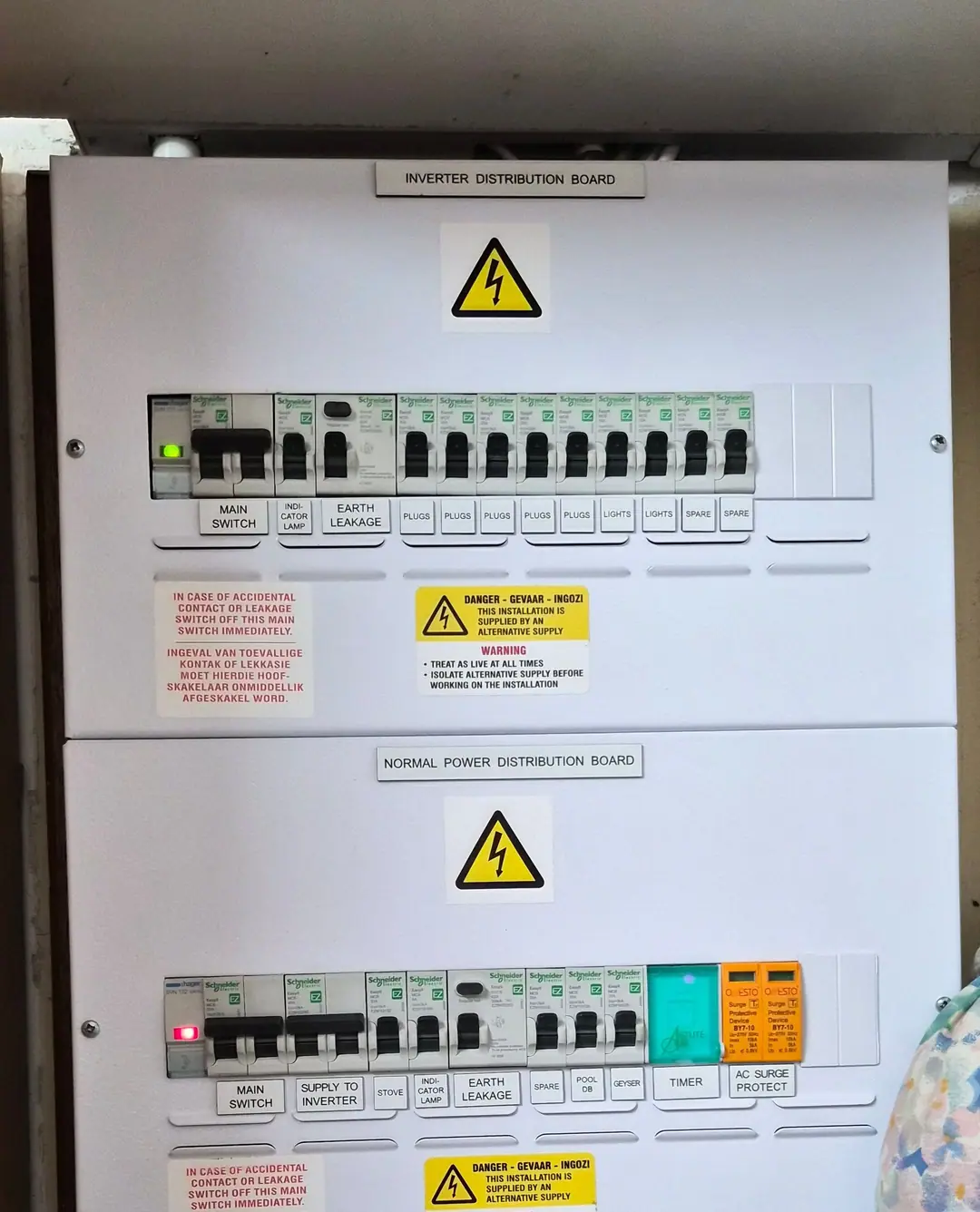
An inverter should not carry the whole house, so the board is split in two. The usual setup is two boards, or two sections of one, like the pair in the photo: an essential DB for the circuits the inverter keeps running, and a normal-power DB for the rest. Lights, plugs for the fridge and the Wi-Fi, the gate and the alarm go on the essential side. The geyser, stove, oven and pool pump usually stay on the normal side.
Getting that split right does more for battery life than buying a bigger battery. It is also far easier to do when the board is being replaced in any case.
The inverter's output should also go through a transfer or bypass switch, so the house can be returned to the normal supply if the inverter needs servicing or fails. Without one, an inverter fault leaves the essential circuits without power until it is repaired.
What happens on the day of a board replacement
The supply is isolated, the old board is removed and the new enclosure is installed. Before any circuit is connected to its new breaker, we test its insulation. This matters because a new earth leakage unit is far more sensitive than an old fuse, and it will detect leaks the old board never registered. It is far better to find a perished cable during the replacement than to have the new board trip on the first night.
Each breaker is sized to the cable it protects, not to whatever was in the old fuse carrier. Circuits are labelled, the earth leakage unit is trip-tested, and the work is certified.